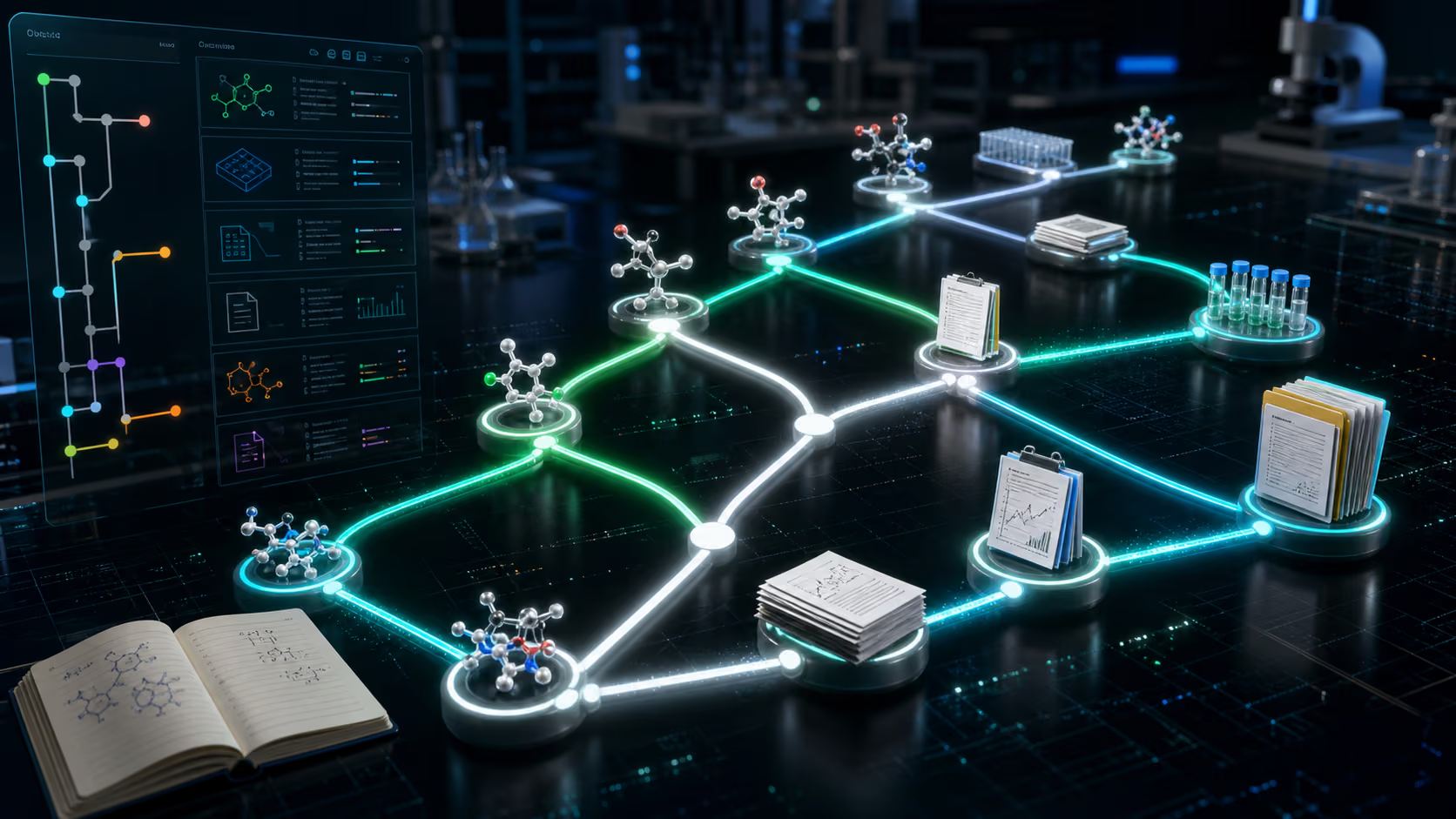
Anyone who has worked on a shared scientific document knows the pattern: one spreadsheet has the latest assay data, another has the cleaned version, and the final report cites a value from a file no one can find anymore. In software, that problem was solved with version control. Every change has an author, a timestamp, a reason, and a path back to the exact state that produced it.
Drug development needs the same discipline. A modern program is not just a molecule; it is a living body of evidence made of hypotheses, data, models, protocols, reports, and regulatory decisions. If those pieces drift out of sync, teams lose time and confidence. If they are versioned together, the program becomes easier to audit, reproduce, and improve.
What Git Actually Adds
Git is a version control system. It records changes to files so teams can see what changed, compare versions, and return to earlier states when needed. Platforms like GitHub, GitLab, and Bitbucket add review workflows, permissions, issue tracking, and collaboration on top of that engine.
For drug discovery, the same ideas translate naturally:
- Every experiment has provenance. The protocol, input data, analysis code, results, and interpretation can be tied to one commit.
- Every decision has context. Teams can see why a molecule was advanced, paused, or redesigned.
- Every document stays aligned. Regulatory summaries can point back to the same source data used by scientists.
- Every reviewer sees the diff. Instead of rereading a 100-page document, reviewers can focus on what actually changed.
Experiments as Code
Pharma-as-code does not mean biology becomes software. It means the artifacts around biology are structured enough to be tested, reviewed, and traced. A cell viability assay might live as a protocol file, a dataset, an analysis notebook, and a short interpretation. A PK/PD simulation might include model parameters, assumptions, outputs, and the decision it informed.
When these artifacts live in Git, a team can answer practical questions quickly: Which assay version produced this result? Which model parameters supported this dose? What changed between the last regulatory draft and this one? Those questions matter because they determine whether a program can move quickly without losing rigor.
AI Needs an Audit Trail
AI agents make version control even more important. When an agent proposes a molecule, drafts an IND section, or updates a trial design, human reviewers need to inspect the work and understand the chain of reasoning. Git provides a familiar review surface: the agent commits a change, scientists review the diff, and accepted changes become part of the program record.
At AgentCures, this makes AI collaboration concrete. The agent can generate research artifacts, but the repository remains the shared source of truth. Human scientists can challenge assumptions, add data, approve changes, and leave a durable record of how the program evolved.
Why It Matters
The value is not only convenience. Version-controlled drug development reduces duplicated work, prevents stale documents from circulating, and gives regulatory teams a stronger evidence trail. It also lets discoveries compound: a useful assay template, model, or safety rationale from one program can be reused across the next.
Pharma-as-code is a practical operating model for AI-driven biotech. It brings software-style precision to scientific work while keeping scientists in control of the decisions that matter.