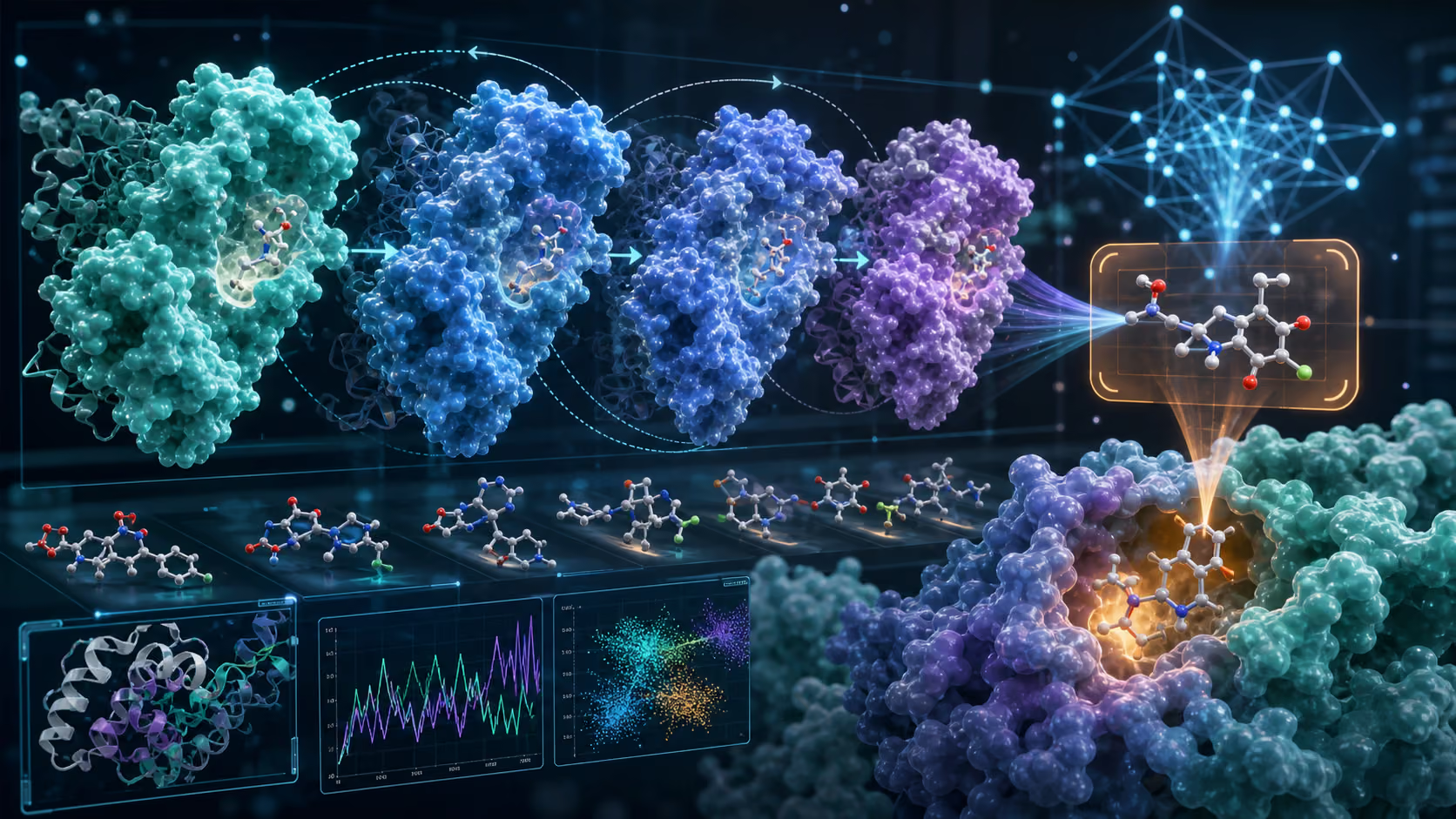
AI tools such as AlphaFold have made predicted protein structures available to many more researchers. Those models can suggest where a molecule might bind and help teams decide which ideas to investigate.
The next question is how to use a structural model alongside the other evidence a drug program needs.
From Structure to Drug Design
A protein’s shape can reveal binding pockets where small molecules may attach and affect its function. Understanding a pocket helps researchers propose structures and compare possible binding interactions.
Experimental methods such as X-ray crystallography and cryo-EM provide another source of structural evidence. Predicted models can help teams get started, but researchers need to assess whether a model is suitable for the design question they are asking.
Understanding Protein Motion
Proteins move between different shapes. A single structure captures only part of that behavior.
Several features matter for design:
- Conformational ensembles: A protein may expose different binding opportunities in different shapes.
- Allosteric sites: Binding away from the active site can still change protein function.
- Protein-protein interactions: Some treatments aim to change how proteins interact with each other.
AgentCures considers structural context when comparing candidates, alongside predicted properties and the available biological evidence.
Structures Are Starting Points
A structure may suggest a pocket or help explain selectivity. It does not establish whether a molecule will be safe, reach the intended tissue, or help patients.
Those questions require other kinds of evidence, including ADMET analysis, disease biology, and experiments.
Integrating Structure Into the Pipeline
Structural information can support several stages of research:
- Target identification: Assess whether a protein has sites that could be useful for drug design.
- Hit generation: Propose molecules that may fit a binding pocket.
- Lead optimization: Compare structural predictions with screening results as candidates change.
- Selectivity engineering: Compare related proteins to investigate unwanted binding.
Keeping these analyses connected makes it easier to revisit a design decision when new evidence arrives.
Putting Structural Data in Context
Experimental and predicted structures give researchers more information to work with. Combining them with genomic and clinical data can help put a target in its disease context.
At AgentCures, the goal is to use that evidence together when deciding which candidates deserve further work.
What This Means for Patients
Better structural understanding can help researchers ask more precise questions about a candidate’s activity and selectivity. The practical test comes when those ideas are checked against experiments and, later, clinical evidence.
Predicted structures are useful inputs to that process, and their strengths and limitations need to stay visible as a program develops.