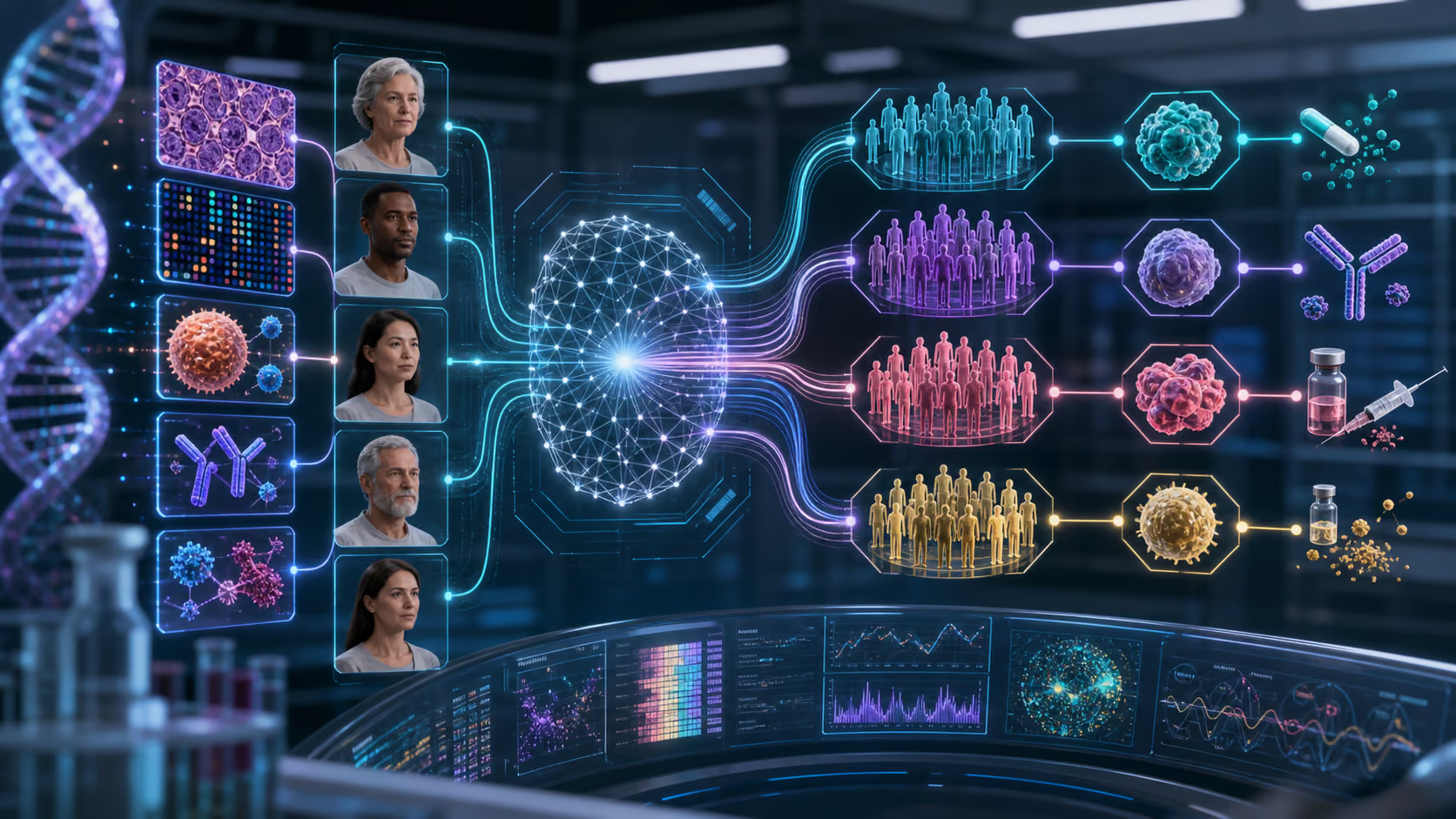
The promise of precision medicine is simple: the right drug for the right patient at the right time. The reality has been far more complicated. Despite decades of progress in genomics and biomarker discovery, many drugs are still used broadly across patients whose biology may be very different.
The gap between promise and reality exists not because we lack data, but because the data is hard to connect at scale. A patient's genome, tumor biology, prior treatments, comorbidities, and real-world outcomes often sit in different systems. AI gives teams a way to reason across those layers without reducing the patient to a single biomarker.
The Patient Stratification Challenge
Every patient is biologically unique. Two people with the same cancer diagnosis may have tumors driven by completely different molecular mechanisms. A drug that works brilliantly for one may be completely ineffective—or even harmful—for the other.
Patient stratification is the process of dividing patients into subgroups based on their likelihood of responding to a particular treatment. Done well, it transforms clinical trials (by enrolling patients most likely to benefit) and clinical practice (by guiding treatment selection).
The challenge is that meaningful patient stratification requires integrating multiple data types:
- Genomic data: Mutations, gene expression patterns, copy number variations
- Proteomic data: Protein expression levels and post-translational modifications
- Clinical data: Disease history, comorbidities, prior treatments
- Demographic data: Age, sex, ethnicity, environmental exposures
No human can hold all of these variables in mind simultaneously. But an AI can.
AI-Powered Stratification
AgentCures' AI agent performs patient stratification as an integrated part of its drug development process. For each drug program, the agent:
- Analyzes multi-omic data to identify biomarkers that predict treatment response
- Builds predictive models that classify patients into responder and non-responder groups
- Designs clinical trials enriched for patients most likely to benefit
- Generates companion diagnostic strategies that can be used to select patients in clinical practice
This is not a post-hoc analysis—it is built into the drug development process from the very beginning. The AI agent considers patient heterogeneity when designing molecules, selecting targets, and planning clinical trials.
What It Means for Patients
For a patient, stratification should feel less like being sorted by a broad diagnosis and more like being matched to a therapy because the biology makes sense. That can mean a smaller but more focused trial, a companion diagnostic that identifies likely responders, or a treatment strategy that avoids exposing non-responders to unnecessary risk.
The Clinical Trial Advantage
Patient stratification has a dramatic impact on clinical trial success rates. A trial enrolling only patients who are biologically likely to respond to the treatment requires fewer patients, runs faster, and is far more likely to demonstrate a statistically significant effect.
Industry data suggests that biomarker-guided trials are approximately twice as likely to succeed as unstratified trials. For Phase III trials, which can cost hundreds of millions of dollars, this difference is transformative.
AgentCures bakes this advantage into every program from the start. Our AI agent identifies potential stratification biomarkers during target selection and refines them throughout the development process.
Scaling Precision Medicine
The ultimate vision of precision medicine is a world where every treatment decision is guided by the patient's individual biology. Achieving this vision requires AI systems that can:
- Process and integrate data from millions of patients
- Continuously update predictive models as new data becomes available
- Generate actionable stratification strategies for every drug program
- Operate at the speed and scale that global healthcare demands
This is the kind of challenge that autonomous AI agents are uniquely suited to address. No human team, regardless of size, could manually analyze the volume and complexity of data required for true precision medicine at scale.
From Bench to Bedside
AgentCures is building the infrastructure to make precision medicine the default rather than the exception. By integrating patient stratification into every stage of drug development—from initial target selection through clinical trial design—we ensure that the medicines we develop are designed for the patients who will benefit most.
The era of one-size-fits-all medicine is ending gradually, disease by disease and trial by trial. AI can accelerate that transition by making patient stratification a routine part of development rather than a late analysis added after a trial is already designed.