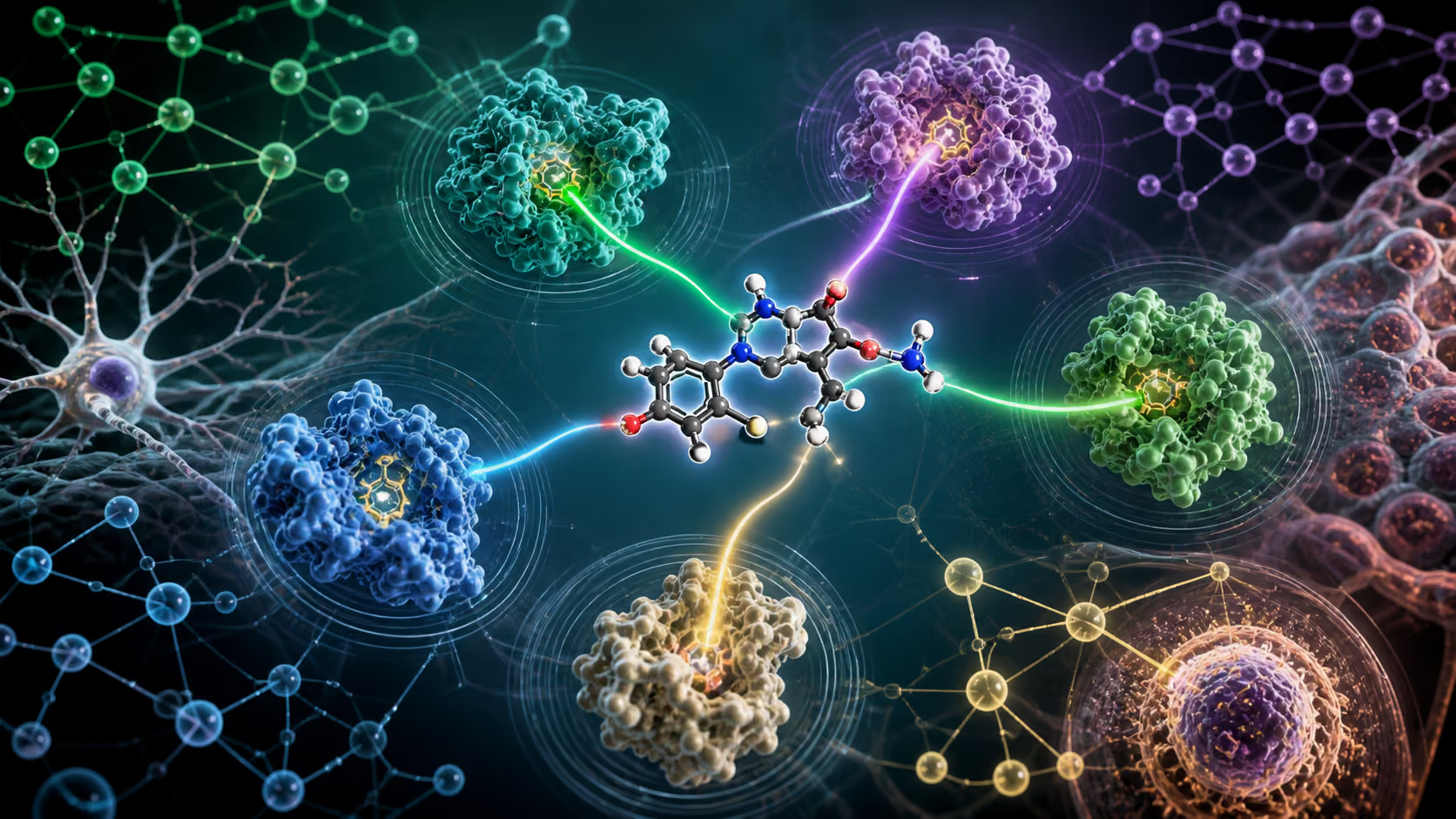
The dominant paradigm in drug discovery for the past three decades has been "one drug, one target." Find a single protein that drives a disease, design a molecule that inhibits it, and hope that blocking that one target is enough to treat the disease.
For some conditions, this approach works beautifully. But for the most devastating diseases facing humanity—cancer, neurodegeneration, autoimmune disorders—single-target approaches have repeatedly fallen short. These diseases are not caused by a single malfunctioning protein. They are driven by complex networks of interacting biological pathways.
The Complexity Problem
Consider Alzheimer's disease. For decades, much of the field focused on amyloid-beta, a protein that accumulates in the brains of Alzheimer's patients. That biology remains important, but Alzheimer's also involves tau aggregation, neuroinflammation, synaptic dysfunction, metabolic changes, and vascular pathology. A single-target lens can miss the broader disease network.
The same pattern repeats across oncology, immunology, and rare diseases. The diseases that are easiest to treat with single-target drugs have largely been addressed. What remains are the complex, multi-factorial conditions that require more sophisticated approaches.
AI Enables Multi-Target Thinking
Designing a drug that modulates multiple targets simultaneously is extraordinarily difficult for human medicinal chemists. The optimization space explodes combinatorially: instead of balancing a molecule's properties against one target, you're balancing against two, three, or more—each with its own binding site, selectivity requirements, and pharmacological constraints.
This is precisely the kind of problem where AI excels. Machine learning models can navigate high-dimensional optimization landscapes that are beyond human intuition. At AgentCures, our AI agent can:
- Identify synergistic target combinations by analyzing genomic, proteomic, and clinical data across patient populations
- Design molecules that engage multiple targets at the appropriate potency ratios
- Predict pharmacological outcomes of multi-target engagement using systems biology models
- Optimize selectivity profiles to ensure the drug hits intended targets while sparing others
Combination Programs at AgentCures
AgentCures' pipeline includes combination drug programs that target multiple biological pathways simultaneously. Our AI agent evaluates these programs holistically, considering not just individual target engagement but the emergent properties of multi-target modulation.
This approach is particularly powerful in oncology, where tumors often develop resistance to single-target therapies by activating alternative signaling pathways. A well-designed multi-target drug can block these escape routes before they emerge.
The Hard Part: Balance
Multi-target therapy is not simply "hit more things." The dose, potency ratio, tissue exposure, and safety window all matter. A useful multi-target drug must engage the right targets strongly enough to shift disease biology while avoiding pathways that create toxicity. That balance is why computational design, systems biology, and careful experimental validation need to work together.
The Data Integration Challenge
Multi-target drug discovery requires integrating data from diverse sources: genomics, proteomics, metabolomics, clinical outcomes, and more. Traditional approaches struggle with this integration because the data lives in different formats across different systems.
AgentCures' unified, version-controlled platform makes this integration natural. All data types are structured, linked, and accessible to the AI agent, enabling the kind of cross-modal reasoning that multi-target discovery demands.
A New Therapeutic Frontier
Multi-target drug discovery is not just a technical advance—it represents a philosophical shift in how we approach disease. Instead of asking "which single target should we hit?", we can now ask "which combination of interventions will most effectively treat this disease?"
This shift opens entirely new therapeutic possibilities for conditions that have resisted decades of single-target drug development. The diseases that have been called "undruggable" may simply have been under-thought.
AI is giving us the tools to think bigger.