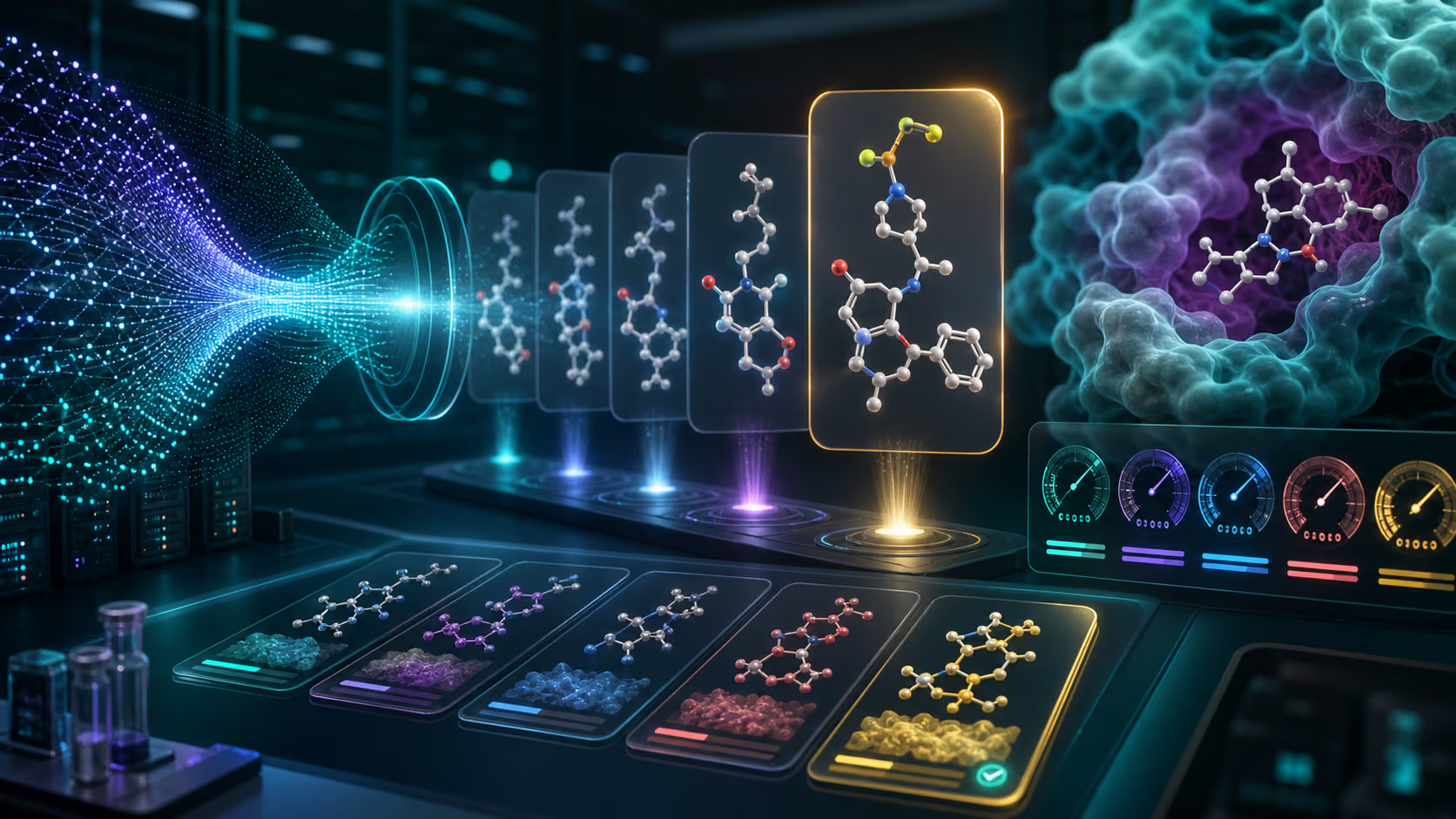
For most of pharmaceutical history, drug discovery has been a process of finding rather than creating. Scientists screened natural products, searched chemical libraries, and tested millions of existing compounds hoping to find one that worked. The chemical space explored was vast by human standards but minuscule compared to the estimated 10^60 drug-like molecules that could theoretically exist.
Generative AI changes the starting point. Instead of only searching through existing molecules, AI can propose new structures tailored to the properties a drug needs to have. The best candidates still need synthesis, assays, and human review, but the search begins in a much richer part of chemical space.
How Generative Molecular Design Works
Generative AI models for molecular design work similarly to the language models that power ChatGPT, but instead of generating text, they generate molecular structures. These models learn the "grammar" of chemistry—which atoms can bond to which, what makes a molecule stable, what makes it drug-like—from millions of known molecules.
Once trained, these models can generate novel molecules that:
- Bind to a specific protein target with high affinity
- Have favorable ADMET properties (absorption, distribution, metabolism, excretion, and toxicity)
- Are synthetically accessible — they can actually be made in a lab
- Avoid known liabilities — they don't trigger toxic pathways or interfere with essential biological processes
The power of this approach is that it can optimize for all of these properties simultaneously, something that is extraordinarily difficult for human chemists to do manually.
Beyond Single-Objective Optimization
Traditional drug design often involves painful trade-offs. Making a molecule more potent might make it less soluble. Improving selectivity might reduce bioavailability. Medicinal chemists spend years navigating these trade-offs through iterative cycles of design, synthesis, and testing.
Generative AI can explore multi-objective optimization landscapes that are too complex for human intuition alone. At AgentCures, our AI agent designs molecules that balance dozens of properties simultaneously, then explains the trade-offs so medicinal chemists can decide which ideas deserve the next round of work.
This is not a theoretical advantage. In benchmark studies, AI-designed molecules have shown superior multi-property profiles compared to those designed by experienced medicinal chemists.
The AgentCures Molecular Engine
What sets AgentCures apart is that molecular generation is not a standalone tool—it is integrated into an autonomous pipeline that:
- Generates thousands of candidate molecules for each target
- Filters them through increasingly stringent computational models
- Predicts their behavior in biological systems
- Ranks them based on likelihood of clinical success
- Documents every design decision and rationale in Git
This pipeline runs continuously, generating and evaluating molecules around the clock. The most promising candidates are surfaced to human scientists for review, along with complete documentation of why the AI agent selected them.
Human Judgment Still Matters
The useful output of a generative model is not a pretty molecule. It is a testable hypothesis. Scientists still ask whether the scaffold is chemically sensible, whether the proposed synthesis is realistic, whether the predicted selectivity fits the biology, and whether the program risk is acceptable. The AI expands the option set; humans keep the program grounded.
Intellectual Property Implications
One of the most exciting aspects of generative molecular design is its implications for intellectual property. Every molecule generated by AI is novel—it has never been synthesized or published before. This creates opportunities for strong patent positions that are difficult to design around.
AgentCures' version-controlled approach provides an additional advantage: every molecule's design history is fully documented, creating an unambiguous record of invention that strengthens patent applications.
The Scale Advantage
A human medicinal chemist can typically design and evaluate a handful of molecules per week. AgentCures' AI agent can generate and computationally evaluate thousands per day. This difference in scale doesn't just accelerate the process—it fundamentally changes the probability of success. By exploring a vastly larger portion of chemical space, AI-driven approaches are more likely to find optimal solutions that brute-force search and human intuition would miss.
The molecules of the future won't be found. They will be invented.