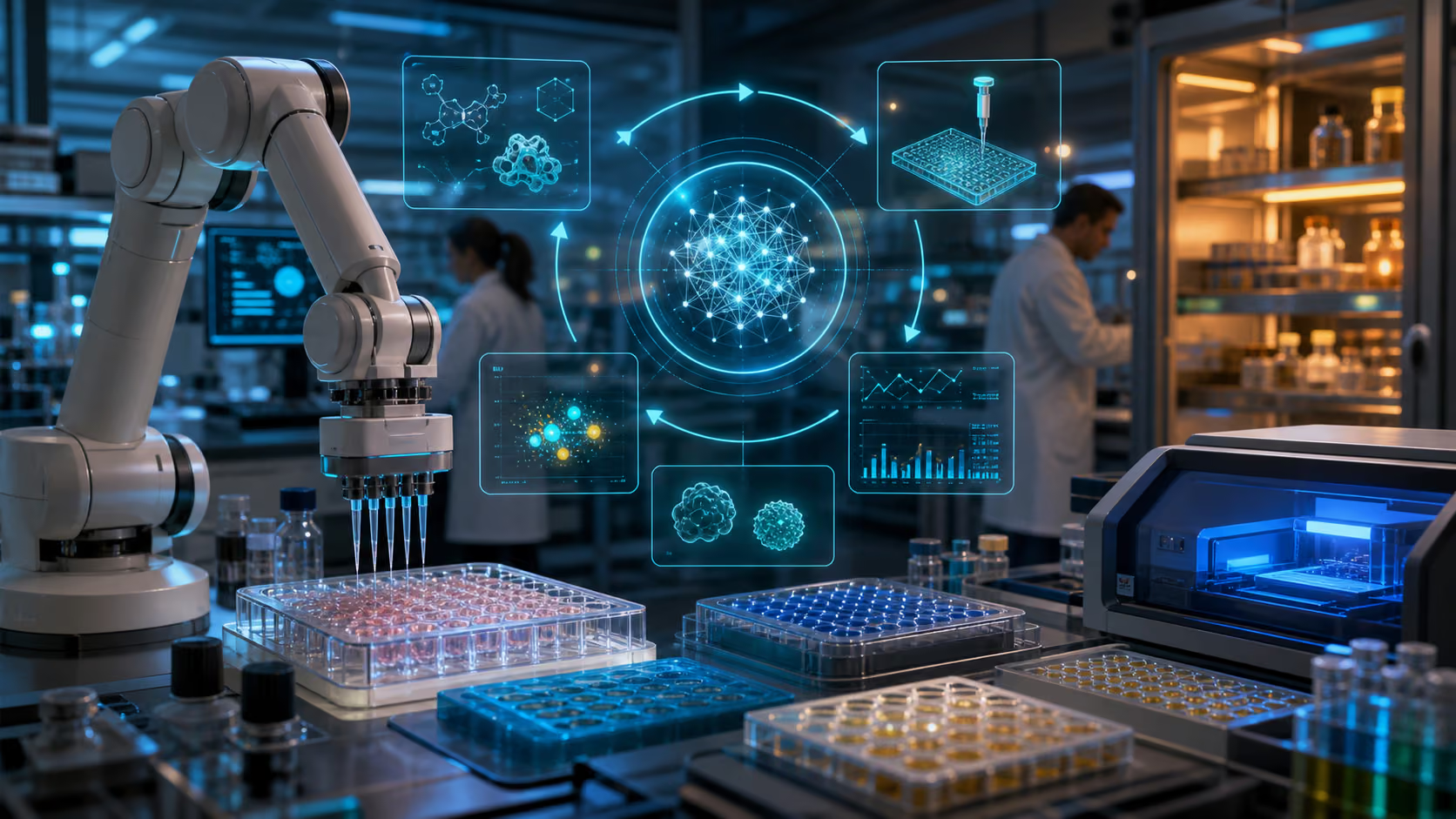
A lab can have sophisticated instruments and still spend days moving results between spreadsheets, emails, and analysis tools. Those handoffs slow down the next experiment.
AI agents can help connect the work: propose a design, plan a test, analyze the result, and update the research record.
What Is an Autonomous Laboratory?
Lab automation usually carries out predefined tasks. An autonomous workflow also uses results to decide what to do next, within the objectives and limits set by the team.
An AI agent can coordinate parts of that process by calling scientific tools, interpreting their outputs, and proposing another step. The extent of its autonomy depends on the available equipment, integrations, and review requirements.
The Design-Make-Test-Analyze Loop
Drug discovery repeats four activities: design a molecule, make it, test it, and analyze the results. Each round informs the next.
An agent can support this cycle by:
- Preparing new designs while an earlier batch is being tested
- Comparing possible synthesis routes
- Analyzing assay results and updating recommendations
- Recording inputs, results, and decisions for review
At AgentCures, we connect computational design and evaluation with experiment planning so results can inform the next research decision.
What Changes for a Scientist
Scientists can spend less time locating files and coordinating routine handoffs. A shared research record helps them focus on what the new data means and whether the plan should change.
The agent’s proposals also give the team something concrete to inspect, question, and revise.
Learning From Each Experiment
Each experiment adds information that may improve later decisions. A failed candidate can reveal a weakness in a model or a design assumption. A successful result can support a method’s use on similar problems.
Keeping those outcomes connected to their original predictions makes it easier to assess what the system is learning and where it still needs work.
Human-AI Collaboration
Scientists set research objectives, define constraints, and review proposals. They also investigate unexpected results and decide when the evidence is strong enough to advance a program.
The agent supports that work by exploring options computationally and keeping analyses organized.
The Competitive Advantage
A connected workflow can reduce the wait between one result and the next useful experiment. Computational screening can also narrow the choices before a team spends time and money in the lab.
The benefit depends on the quality of the decisions that follow. We want each round of work to produce evidence the team can understand and use.