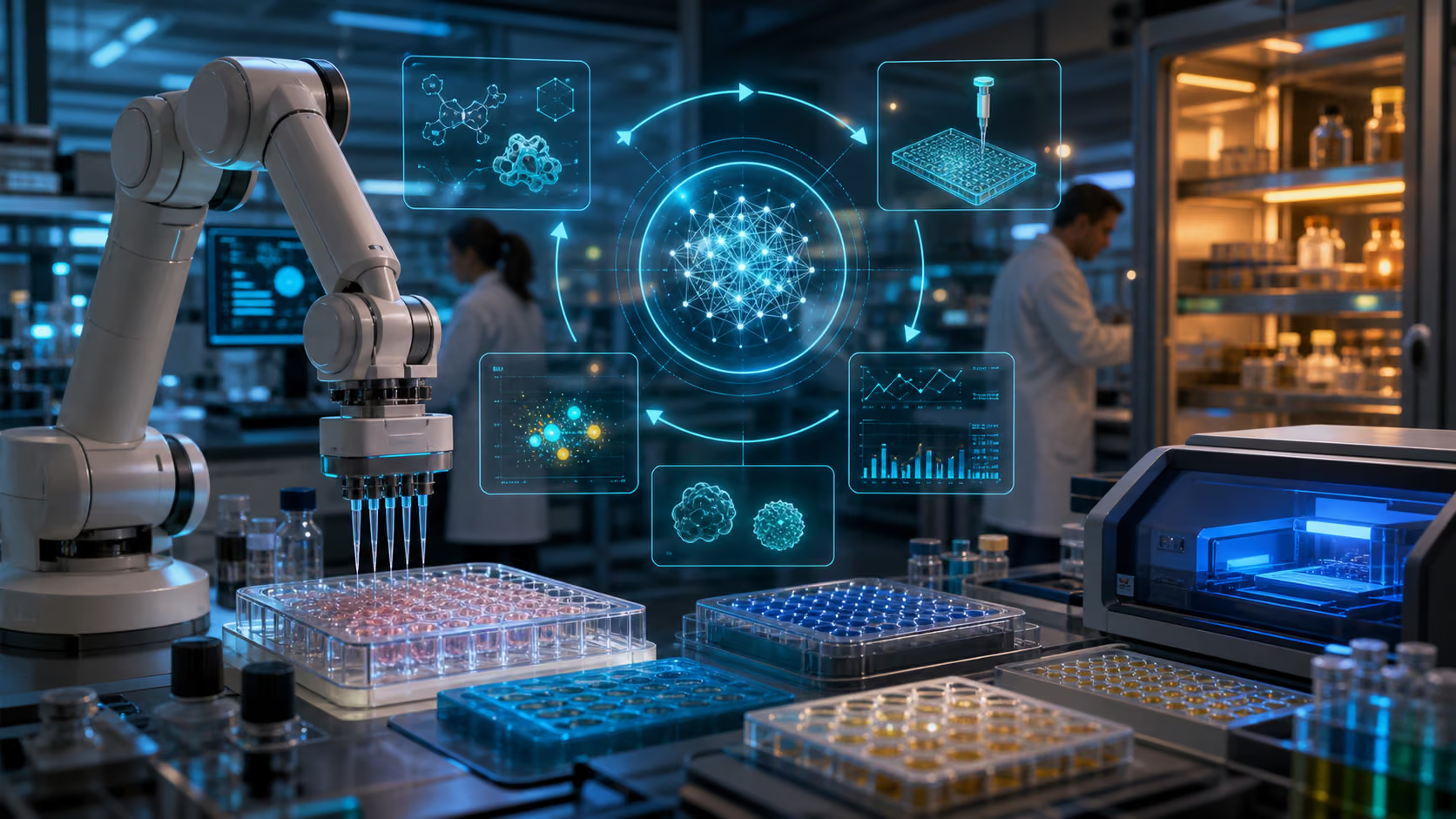
The modern drug discovery laboratory is a paradox. It houses some of the most sophisticated instruments on Earth—mass spectrometers, high-throughput screening platforms, cryo-electron microscopes—yet the workflow connecting these instruments often still depends on spreadsheets, email chains, and manual handoffs. The instruments are 21st century; too much of the process is still 20th century.
This disconnect is precisely what autonomous AI agents are designed to solve.
What Is an Autonomous Laboratory?
An autonomous laboratory is not simply a lab with robots. Robotic automation has existed for decades. What makes a laboratory truly autonomous is an AI agent that serves as the lab's decision-making brain—designing experiments, interpreting results, and deciding what to do next, all without waiting for a human to review every data point.
Think of it as the difference between cruise control and a self-driving car. Cruise control maintains speed; a self-driving car navigates the entire journey. Similarly, robotic automation performs predefined tasks; an autonomous AI agent navigates the entire experimental journey.
The Design-Make-Test-Analyze Loop
Drug discovery follows a fundamental cycle: Design a molecule, Make it (synthesize), Test it (assay), and Analyze the results. Traditionally, each step involves handoffs between teams, meetings to review data, and weeks of waiting for results to inform the next round of designs.
An autonomous AI agent collapses this cycle. It can:
- Design the next round of molecules while the current batch is still being tested
- Predict which synthetic routes are most likely to succeed
- Analyze assay results in real-time and immediately update its molecular design strategy
- Document every decision in a version-controlled repository, creating a complete audit trail
This is not a theoretical capability. At AgentCures, our AI agent continuously cycles through this loop, generating and evaluating thousands of molecular hypotheses in the time it would take a traditional team to evaluate a handful.
What Changes for a Scientist
In an autonomous lab, scientists spend less time coordinating handoffs and more time setting the direction of the research. Instead of asking "has the assay data been uploaded yet?", they can ask "what did the new data teach us, and should we change the objective?" That is a higher-value use of scarce scientific attention.
The Data Flywheel
The most powerful aspect of the autonomous laboratory is the data flywheel it creates. Every experiment generates data that makes the AI agent smarter. Every failed molecule teaches the system what doesn't work. Every successful lead validates the agent's predictive models.
Over time, this creates an exponential advantage. A company running an autonomous laboratory doesn't just move faster—it gets progressively faster with every experiment it runs.
Human-AI Collaboration
The autonomous laboratory does not eliminate the need for human scientists. Instead, it fundamentally changes their role. Scientists shift from being the rate-limiting step in experimental execution to being the strategic directors of research programs. They set the objectives, define the constraints, and review the AI agent's proposals—while the agent handles the exhaustive computational work of exploring chemical space.
This is the model AgentCures has adopted: AI and humans as partners, each contributing what they do best.
The Competitive Advantage
For biotech companies, the autonomous laboratory represents a step-function change in productivity. A single AI agent can explore more chemical space in a day than a team of medicinal chemists can in a year. It can run thousands of virtual experiments before committing a single dollar to wet-lab work. And it can do all of this while maintaining perfect documentation and reproducibility.
The companies that adopt this model well will have a durable advantage in the race to bring new medicines to patients. The winners will not be the labs with the most automation alone, but the ones that connect automation to better decisions.