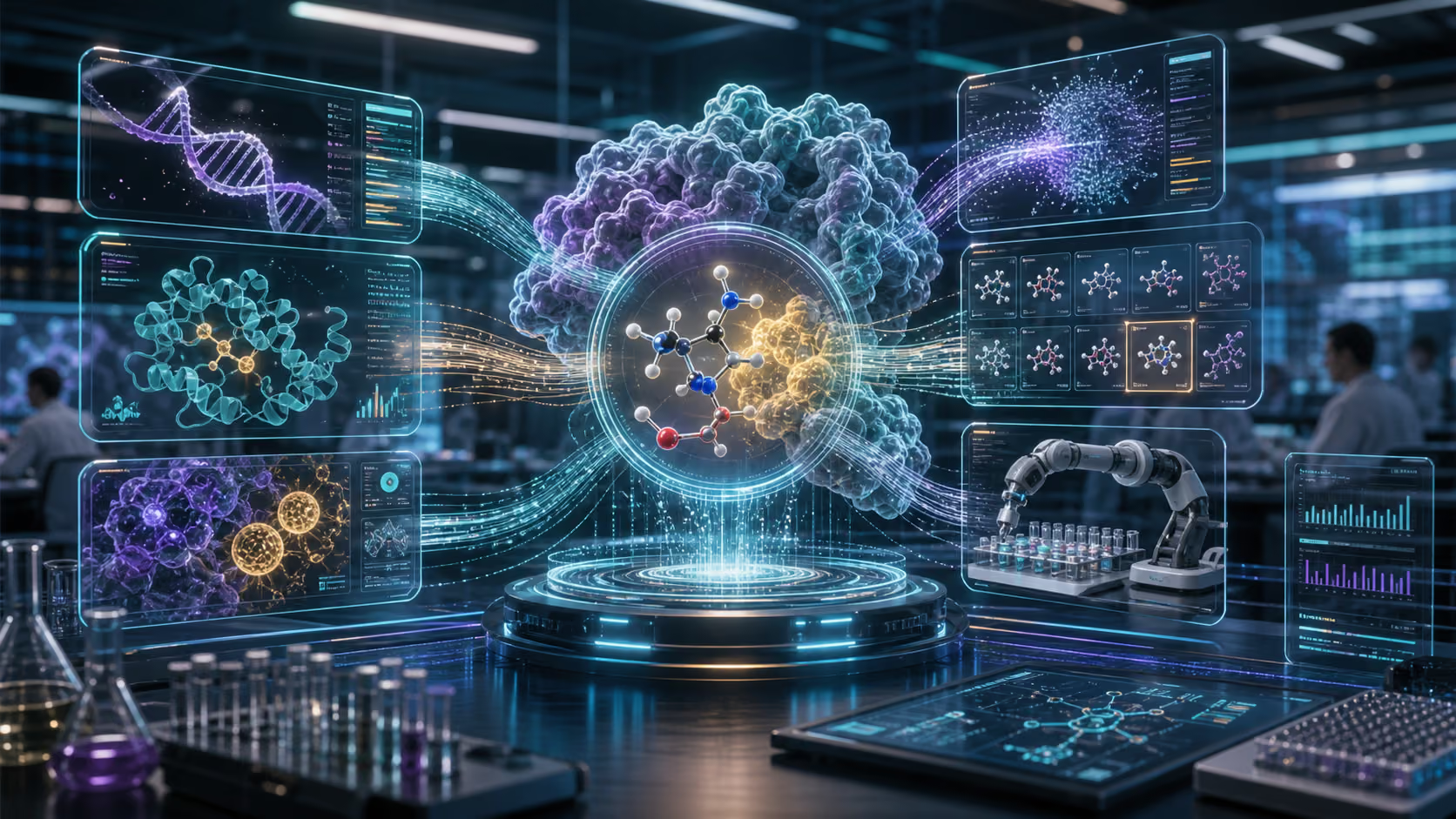
The pharmaceutical industry has operated under the same broad paradigm for decades: identify a target, screen compounds, optimize a handful of leads, and hope one survives the gauntlet of clinical trials. The process can take 12–15 years, often costs billions when failures are included, and still fails more often than it succeeds.
AI will not remove biology's uncertainty, but it can make the search more disciplined. It can help teams ask better questions earlier, test more hypotheses computationally, and document why each program decision was made.
The Convergence of AI and Biology
Artificial intelligence is not simply making the old process faster—it is creating an entirely new paradigm for how medicines are discovered and developed. Machine learning models can now predict molecular properties with remarkable accuracy. Generative models can design novel compounds that have never existed in nature. And autonomous AI agents can orchestrate entire research programs with minimal human intervention.
What makes this moment different from previous waves of computational biology is the convergence of three critical factors:
- Massive biological datasets — Genomics, proteomics, and high-throughput screening have generated petabytes of structured data ready for AI consumption.
- Foundation models for chemistry and biology — Large language models trained on scientific literature and molecular data can reason about biological systems in ways that were previously impossible.
- Autonomous AI agents — Systems that don't just predict outcomes but actively design experiments, analyze results, and iterate on hypotheses without waiting for human input.
From Prediction to Action
Early applications of AI in pharma focused on prediction: will this molecule bind to that target? What are the likely side effects? These tools were valuable but limited—they still required human scientists to act on every prediction.
The breakthrough came with agentic AI: systems that close the loop between prediction and action. An AI agent doesn't just flag a promising molecular scaffold. It can propose a synthesis route, predict ADMET properties, evaluate the competitive landscape, draft an experimental protocol, and then update the plan when new data arrives.
At AgentCures, this is the operating model: AI-generated proposals, human review, version-controlled decisions, and rapid iteration.
Why Speed Matters
In drug discovery, speed is not just a business advantage. Every month of delay affects patients, families, and clinicians waiting for better options. The point is not to rush unsafe drugs into humans; it is to remove avoidable delays from decisions that can be made earlier and with better evidence.
AI-driven drug discovery can compress these timelines by moving more hypothesis testing into computation. What once took years of iterative screening can sometimes be narrowed through weeks of computational exploration. What once required months of manual data analysis can now be completed in hours by AI systems that run continuously and document their work.
The AgentCures Approach
AgentCures represents the next evolution in this transformation. Our platform is built on a simple but powerful principle: everything that can be automated, is automated. Our AI agent doesn't just assist scientists—it operates as an autonomous research partner, capable of:
- Designing novel molecules optimized for multiple properties simultaneously
- Predicting clinical outcomes using multi-modal biological data
- Generating regulatory documents including IND applications and clinical protocols
- Version-controlling every decision through Git-based provenance tracking
The result is a drug discovery engine that operates at machine speed while maintaining the rigor and transparency that regulators and patients demand.
What Comes Next
We are at the beginning of what will be the most productive era in pharmaceutical history. The combination of autonomous AI agents, massive biological datasets, and modern software engineering practices is creating a new class of biotech company—one that can pursue dozens of drug programs simultaneously at a fraction of the traditional cost.
The question is no longer whether AI will transform drug discovery. The practical question is which teams can pair AI speed with scientific discipline, regulatory clarity, and enough humility to learn from the data.