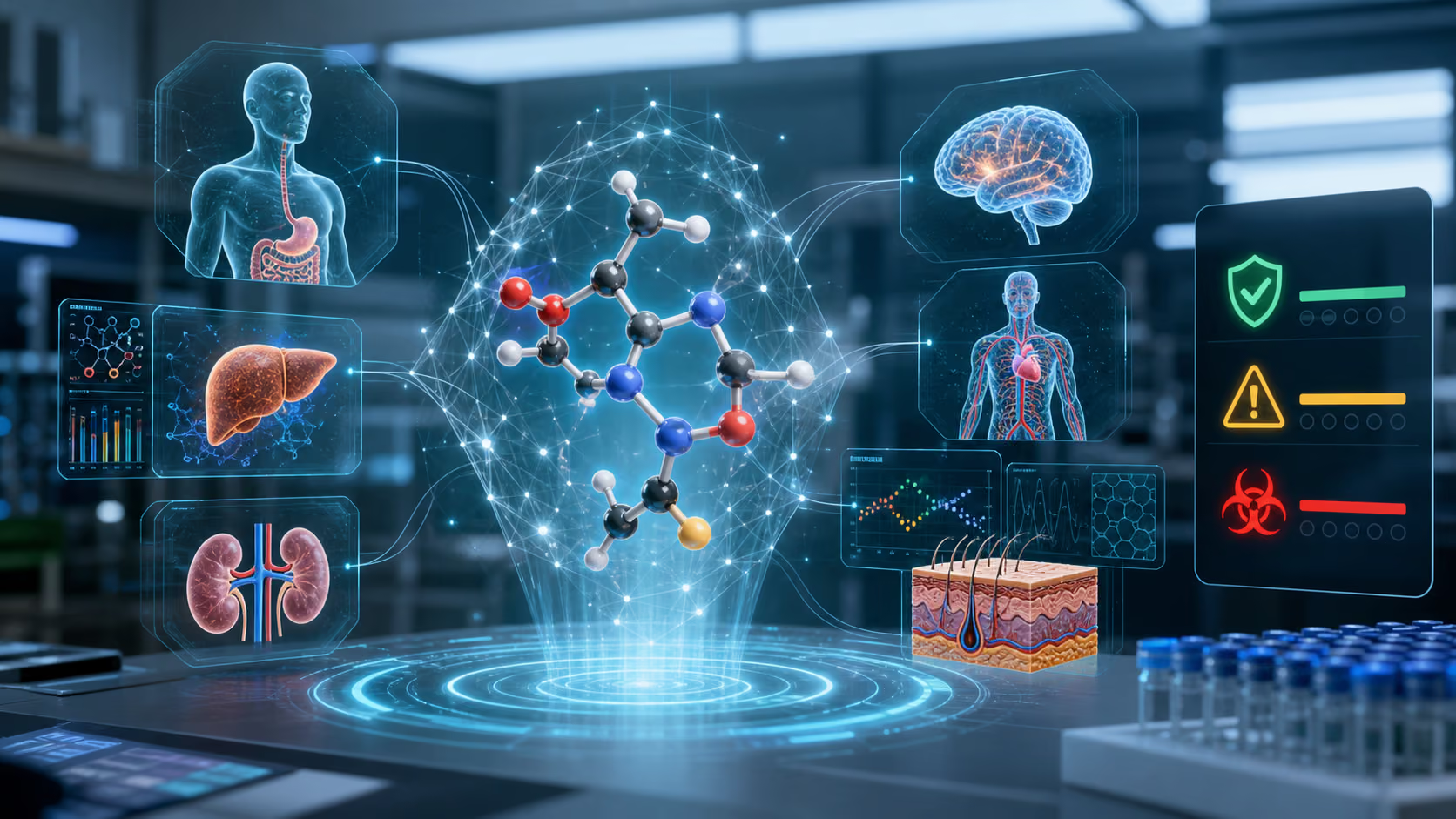
A molecule can bind to its target with exquisite potency and still fail as a drug. The reason is often ADMET: the pharmacokinetic and safety profile that determines whether a molecule can reach the right tissue, stay there long enough to help, and leave the body without causing unacceptable harm.
Absorption: Can the drug get into the bloodstream? Distribution: Does it reach the right tissues? Metabolism: Is it broken down too quickly—or too slowly? Excretion: Can the body clear it safely? Toxicity: Does it cause unacceptable harm?
Poor pharmacokinetics and toxicity remain major causes of attrition. These failures are particularly costly because they can appear late, after a program has already consumed years of work and substantial capital.
The Traditional ADMET Challenge
Historically, ADMET properties were assessed through a combination of in vitro assays (cell-based experiments) and in vivo studies (animal testing). These experiments are time-consuming, expensive, and—in the case of animal studies—ethically fraught.
Worse, ADMET assessment was traditionally treated as a gatekeeping step rather than an integral part of the design process. Medicinal chemists would design a molecule for potency, then "throw it over the wall" to the ADMET team, only to learn weeks or months later that the compound had fatal pharmacokinetic liabilities.
This sequential approach is one of the primary reasons drug discovery takes so long.
The human cost is easy to miss. Every late ADMET failure means patients waited for a medicine that could not safely become one, while researchers, donors, and investors poured effort into a path that might have been ruled out earlier.
AI-Driven ADMET Prediction
Machine learning models trained on large datasets of experimentally measured ADMET properties can now predict these parameters with remarkable accuracy. AgentCures' AI agent leverages these models to evaluate ADMET properties at the point of molecular design, not after synthesis.
This means:
- Molecules with poor absorption are never synthesized. The AI agent evaluates oral bioavailability predictions before recommending any molecule for synthesis.
- Metabolic liabilities are identified computationally. The agent predicts CYP450 interactions, metabolic soft spots, and clearance rates in silico.
- Toxicity risks are flagged early. Structural alerts, hERG channel inhibition predictions, and reactive metabolite formation are assessed before a molecule ever enters a test tube.
- Drug-drug interactions are anticipated. The agent evaluates potential interactions with commonly co-prescribed medications.
Multi-Property Optimization
The real power of AI in ADMET is not just prediction—it is optimization. AgentCures' generative molecular design engine optimizes for ADMET properties simultaneously with target potency and selectivity. This multi-property approach reduces the traditional trade-off cycle where improving one property degrades another.
The AI agent navigates a chemical design space that balances:
- Target binding affinity
- Selectivity over related proteins
- Oral bioavailability
- Metabolic stability
- Aqueous solubility
- Permeability
- Safety margins
Finding molecules that satisfy all of these constraints simultaneously is a needle-in-a-haystack problem for human chemists. For AI, it is a tractable optimization problem.
What Better ADMET Looks Like
Better ADMET optimization is not one score. It is a set of practical decisions: avoid a hERG liability before synthesis, redesign a scaffold before clearance becomes unmanageable, improve solubility without losing potency, and choose a dose that leaves enough safety margin. Each decision removes risk before it becomes expensive.
Reducing Animal Testing
AI-driven ADMET prediction has a significant ethical dimension. By predicting pharmacokinetic and safety properties in silico, the need for animal testing can be substantially reduced. Molecules with obvious liabilities can be filtered computationally, meaning fewer compounds require animal studies.
AgentCures is committed to the principle that no animal experiment should be run if a computational approach can provide the same information. As our AI models improve, the proportion of questions that can be answered computationally will only increase.
The Impact on Development Timelines
By integrating ADMET prediction into the earliest stages of molecular design, AgentCures reduces one of the most common sources of late-stage failure. Molecules that enter preclinical development from our pipeline have already been computationally vetted for drug-like properties, lowering attrition risk as they progress through development.
The result is a faster, more predictable path from molecule to medicine. For patients, the benefit is simple: fewer unsafe candidates entering the clinic and more serious programs arriving with a stronger safety rationale.